Contactless and hygienic
No shared surface. In clinics, food handling and post-pandemic offices this stopped being a nice-to-have and became a requirement.
Face Recognition Attendance
Modern face terminals recognise an employee in under a second, work through UAE daylight and masks, and never require a colleague's finger to be pressed against a shared surface. Ideal for hygiene-sensitive workplaces and busy entrances.
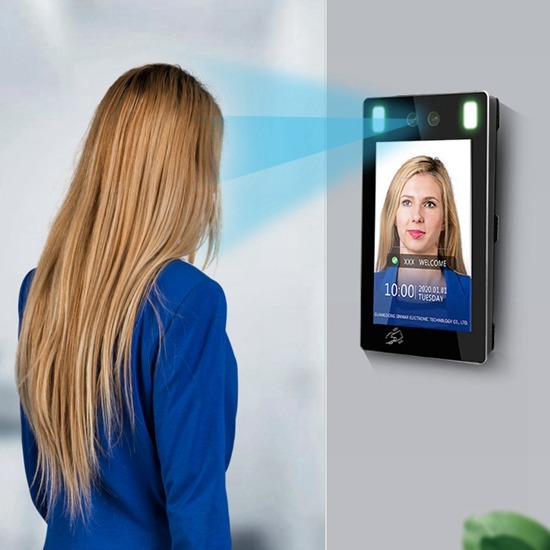
The terminal captures an image of the face, extracts a set of geometric measurements (distances between eyes, cheekbones, jaw shape) and stores them as a template. Later scans are matched against that template in under a second. A photograph, a video on a phone or a printed mask cannot pass, modern anti-spoofing checks liveness through infrared and depth. Masks and glasses are handled by matching the visible features rather than requiring a full face view.
The right technology when hygiene, speed or hand condition rules out fingerprint.
No shared surface. In clinics, food handling and post-pandemic offices this stopped being a nice-to-have and became a requirement.
Under a second per employee, so a 200-person shift change clears without a queue at the door.
Terminals match the geometry that stays visible. A mask does not defeat modern algorithms; a badly lit fingerprint reader does.
Liveness detection through infrared and 3D depth stops photographs, videos and printed masks. The unit knows a real face from an image on a phone.
For construction, warehouse and kitchen workforces whose fingerprints will not read, face recognition works where a fingerprint reader simply cannot.
Employees do not need to touch or line up precisely. They walk toward the door and the terminal is done by the time they reach it.
A face terminal facing direct sunlight will struggle. We position units perpendicular to the door and away from glare during the survey. Reception spaces are ideal; a west-facing gate is not.
A face enrols in about two seconds and stores a richer template than a fingerprint. Terminal capacity is measured in thousands of faces rather than tens of thousands, so specification matters for large sites.
Outdoor face terminals rated for UAE summer heat are more expensive than indoor units. For a compound gate, we often recommend a fingerprint or card reader outdoors and face recognition at the internal main entrance.
The stored template is mathematical, not a photograph, but we recommend telling your workforce clearly what is captured, where it is stored and how long it is kept. We provide a sample notice with every installation.
Every model we supply, with the full manufacturer specification and the datasheet PDF on each page.
Lower-cost alternative for offices with clean, undamaged fingerprints.
The full biometric range with head-to-head comparison.
BioStation 3 and FaceStation F2, the flagship face terminals for high-throughput doors.
SpeedFace-V5L and ProFace X, the volume face terminals in the UAE market.
Yes. Modern terminals match the geometry above the mask (eyes, brow, upper cheekbones). Recognition is slightly slower with a mask but still reliable.
No. Anti-spoofing uses infrared and depth sensors to detect a living face. A printed photo, a photo on a phone screen and a video all fail liveness detection.
The best terminals handle daylight well, but no face terminal loves direct glare. We position units perpendicular to the door and away from the sun during the site survey.
No. The image is converted to a mathematical template and discarded. The template cannot be reversed into an image, and on Suprema devices it is protected by a certified secure element.
A single-terminal installation with a ZKTeco SpeedFace-V5L typically starts around AED 3,950 excluding VAT covering hardware, cabling, software, enrolment and training. Suprema flagship terminals for reception areas cost more.
Typical face terminals store 3,000 to 50,000 faces depending on model. For sites beyond that, we deploy multiple terminals reporting into one central database.
Free site survey covers lighting, mounting position and headcount. We recommend the right terminal and price it in writing before you commit.
A specialist replies within 2 working hours.